Jenny Hammond
The Chemistry of DeathJenny Hammond is introduced as a considerate village schoolteacher whose emerging relationship with David Hunter becomes central to both of their attempts to live beyond traumatic loss. Her early instinct to care for a distressed child, and her later decision to trust David with painful parts of her past, establish a character whose apparent move to a safe rural life will be severely tested.
Identity and Introduction
Jenny first appears beside Sam Yates in the school’s small sick bay, speaking soothingly and showing him a book while he sits tired and upset. She explains that he has had bad dreams, then volunteers to stay with him until help arrives, arranging for someone else to cover her class. Only after making this practical offer does she realize she has not introduced herself. She gives her name as Jenny Hammond and identifies herself as Sam’s teacher, revealing a combination of attentiveness and self-conscious warmth.
Her first meeting with David Hunter is professional, but the exchange gives way to a more personal acquaintance. They recognize one another from The Lamb, where they meet again after the public search. Jenny has gone out because her housemate is away and the evening feels wrong for being alone; David offers to buy her a drink just as she prepares to leave, and their overlapping gestures of politeness make them laugh. He later offers her a lift, but they walk instead: her rented cottage is only a few hundred yards away, and the night is warm and clear. During the walk, she talks about teaching and mentions that she previously worked at a school in Norwich, then quickly moves on from the subject. David notices the change but does not press her.
That brief reticence marks a boundary Jenny has not yet chosen to cross. At this stage she is newly established in Manham village, known to David through the school and their encounters at the pub, while her earlier life remains largely private. Their first conversations are hesitant, yet the ease of walking together and the shared willingness to offer care establish the beginnings of trust.
Past Trauma and Growing Trust
Jenny Hammond’s move to Manham followed an assault in the city about eighteen months earlier. After a night out, she took a taxi home; the driver stopped and attacked her. She escaped when people crossed the car park nearby and heard her calling for help, but the driver fled before she could identify him. The police could not obtain a useful description or trace the taxi company. Although her physical injuries were limited, the attack left her afraid to go out, not only because she might encounter the same man again but because danger seemed capable of arriving without warning. She accepted a teaching job in Manham in the hope that a quiet, rural place would feel safe.
That hope did not erase the fear. When Jenny later explained why she had left the city, she acknowledged that the move had not made her feel secure; the village itself was now the setting of a murder investigation and mounting anxiety. Her account gives context to the guardedness David had noticed when she mentioned her earlier teaching job in Norwich and then changed the subject. In telling him what had happened, she lets him see the experience behind that reticence, while his response makes clear that her presence matters to him.
Jenny also lives with type 1 diabetes and uses a low dose of insulin. She mentions the condition while explaining that she needs to monitor what she eats and drinks, and notes that Henry Maitland arranged her prescription when she first moved to Manham. This practical detail becomes consequential during her later captivity: without her regular injections, her blood sugar rises and her health deteriorates. Her illness is thus not simply background characterization; it shapes the immediate physical danger she faces when she is unable to care for herself.
As Jenny and David grow closer, their histories become a basis for mutual recognition rather than a subject they need to explain at length. At dinner in Horning, David tells her about Kara and Alice and about his forensic work with Mackenzie. Jenny listens, briefly touches his hand, and affirms his decision to help with the investigation. They share an awareness of how suddenly ordinary life can give way to tragedy, which the narration presents as a private understanding between them. Their easy conversation on the journey back falters as they near Manham, a shift that leaves their new intimacy still tentative even as it has begun to offer each of them a way beyond isolation.
Captivity, Rescue, and Recovery
Jenny’s disappearance turns the unease surrounding her new life into immediate danger. When David reaches her house, ordinary traces of an interrupted afternoon remain: a half-eaten sandwich on the barbecue table, a radio still playing, and the back door standing open. The police have cordoned off the property, but Jenny is nowhere to be found. The scene marks a sharp reversal from the tentative domestic ease she and David had begun to share; the familiar house offers evidence of a sudden departure, not an explanation.
In captivity, Jenny has no reliable sense of time or of the space around her. She gradually learns to orient herself by slits of light coming through cracks, naming the direction they indicate Front. Later, waking in darkness, she recognizes the hard floor and the circumstances of her confinement. She has been trying to conserve her strength and find moisture, but the small patches of water available to her do little to relieve her thirst. Her type 1 diabetes makes the isolation especially dangerous: she realizes she may have missed two or three insulin injections, and her blood sugar is rising as exhaustion and shock compound her condition. A serious foot wound and blood loss further weaken her, while darkness prevents her from judging how much she has lost.
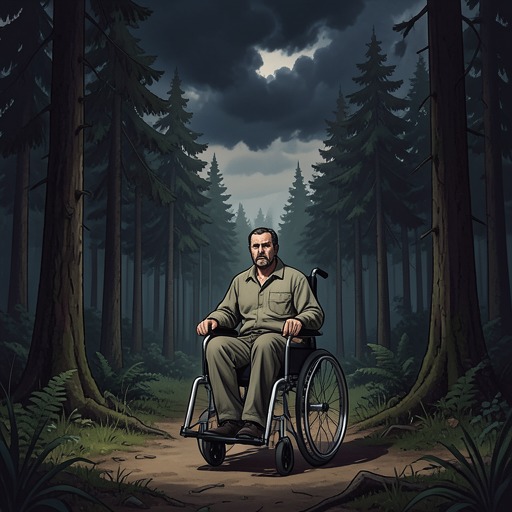
The sounds she hears from the adjoining cellar do not bring reassurance. Someone else is nearby, but Jenny understands that the movement does not mean rescue. When the confinement eventually leads her into the same room as David and George Mason, she is gravely weakened yet still capable of acting. As George Mason threatens David, Jenny intervenes with a large knife; the interruption gives David the chance to fight back and stop him. She collapses, and David finds her barely responsive but alive. Her intervention is decisive: she is not merely the person David has come to save, but an active participant in the moment that ends the immediate threat.
Jenny’s survival remains precarious after the rescue. Her heart stops shortly after she reaches hospital and stops again an hour later, but medical staff restart it each time. She regains consciousness after three days and leaves intensive care after a week. Doctors’ fears of lasting brain or organ damage and blindness do not come to pass. The recovery is physical and psychological: the fear that had driven her from the city has been confronted in its most extreme form, and she no longer feels governed by it. The account places her survival alongside David’s own recovery from grief, presenting their return to life as parallel consequences of having endured the crisis.
Narrative Perspective and Significance
Jenny’s captivity briefly changes the novel’s vantage point. The surrounding investigation is largely filtered through David, but in the darkness the narrative follows Jenny as she searches for a usable point of reference, distinguishing narrow cracks of light and calling their direction Front. Later, she wakes without knowing where she is, then reconstructs her situation from the hard floor, her thirst, and the sounds beyond the cellar planks. This shift gives her confinement an unfolding logic of its own: the reader encounters uncertainty and danger through her efforts to orient herself, rather than only through David’s search for her.
That independent perspective also shapes the rescue’s meaning. When David finally finds Jenny with George Mason, she is gravely weakened, but she acts before David can overcome him, creating the opening that allows the confrontation to end. The narrative thus brings their separate experiences together without making her survival simply the result of his intervention. Her recovery and David’s are linked, but neither erases the ordeal the other has undergone; the ending presents their renewed life as something they have each had to fight to reach.